

Thriving organizations aside, many associations are facing mounting challenges, from engaging diverse audiences to navigating financial instability in the face of economic difficulties. The Continuous THRIVE Model is a practical and customizable framework designed by Direct Objective Consulting to help organizations overcome these challenges. Built on six foundational pillars, the model provides associations with actionable solutions for sustainable growth.
In general, the Continuous THRIVE model:
- Defines and quantifies unique value aligned with your strategic direction.
- Explores new avenues for financial stability and viability.
- Enhances operation agility.
- Customizes data collection and KPIs for faster decision-making.
- Ensures a collaborative approach to building thriving organizations.
- Focuses on engagement and retention.
- Maintains long-term continuous growth.
If you’re wondering how these will translate into real-world examples of the framework application, the following actual examples will showcase the transformative impact on past associations’ success:

1. Driving Engagement with Technology
Challenge: A member-based association struggled with low member engagement. After the Direct Objective team conducted an initial analysis, we discovered that only 21% of the association’s members accessed the most valuable resources and tools, resulting in members not gaining the full membership value potential. In another survey, we verified whether members are aware of the association’s resources and tools and if they deem these resources important. When we learned that most members were unaware of these critical resources and tools, it was clear why they exhibited little involvement. So, what kind of solution can assist in this case?
Solutions: The Continuous THRIVE framework enabled the Direct Objective experts to analyze the six pillars of the framework and suggest a combined approach. While a desktop member portal was present, the member usage data indicated low usage. It was critical to implement a solution that addresses multiple aspects of the low engagement. We noticed that most of the traffic to the membership portal was coming from mobile devices. Thus, implementing a mobile-friendly version of the membership portal was a critical direction. But can you solely rely on that to increase member engagement rates?
Obviously not. We mapped the members’ lifecycle and journey, assessed the existing membership data and introduced a set of marketing automation tools that will trigger the proper use of the membership portal at the right time. Leveraging integrated gamification enabled the introduction of features such as contests and awards, making the member experience more interactive. QR code functionality facilitated the use of the mobile portal while providing the ability to collect additional behavioural membership data.
Results: Using the mobile portal, members interacted with the association’s resources and tools three times more frequently than before. It allowed on-the-fly access, especially with the smooth integration with the QR codes that created a mobile-first experience. The gamification sparked enthusiasm and loyalty. This wasn’t just a technology upgrade but a shift in how members experienced and valued their relationship with the association. It also created word-of-mouth that led to an increase of 11% in new membership during the same period.

2. Making Data Work for You
Challenge: A large member-based association contacted us to assist them with acquiring new members. It all started with the province of Quebec and soon expanded across Canada and the US. With little data available, recruitment efforts involved more guesswork rather than a systematic process. Failing to design and implement a successful member recruitment execution will directly impact an association’s financial stability, as it limits your ability to replicate the growth results year after year.
Solutions: The Direct Objective team suggested a full-service recruitment process. Using the Continuous THRIVE Model, we revised the existing workflow of acquiring new members and designed an improved end-to-end process that relied on:
- Multi-channel demand creation (digital and traditional)
- Account-based marketing (ABM) with hyper-personalization
- Consistent value enhancement using nurturing of prospective members
- Constant data collection plus account scoring, assessing levels of engagement and intention to become a member
The high-quality data enabled us to pinpoint prospective members who are ready to become paying members and those who require further education regarding membership benefits. Having an integrated data repository allowed us to understand the impact of different campaigns and act promptly based on the results.
Results: High-quality data enabled intelligent decision-making and more effective and economical member acquisition. Initially, membership grew in Quebec by 33% between 2014 to 2017. Then, Membership surged by 235% across North America in just three years (2017-2020). While the association experienced a slight decline (16%) during the COVID-19 pandemic, membership recruitment levels rebounded quickly to surpass pre-pandemic rates. This solution is an excellent example of long-term growth (over 10 years) that depends on sophisticated and integrated behavioural data that secure sustainable success.
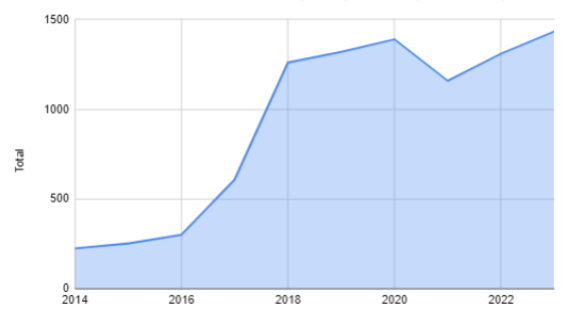
North American Annual Member Acquisition (2014-2023)
3. Securing Financial Stability with Revenue Diversification
Challenge: Associations often rely on membership fees for revenue, leaving them vulnerable, especially in times of crisis. This association was fortunate, as they approached Direct Objective experts about a year before the COVID-19 pandemic. Back then, 70% of an association’s revenue came from membership fees. The rest came from in-person seminars, events, and conferences. Our team advised their board of directors that the revenue ratio was too high. While hesitant, they agreed to a 3-year plan to increase the non-dues revenue portion and reduce the dominance of membership fees.
Solutions: Using the THRIVE model, the Direct Objective team diversified the association’s revenue streams. We gradually introduced virtual events in parallel to in-person gatherings. Initially, the virtual events were promoted to members residing away from major Canadian cities. Suddenly, the online events enabled those members who previously had to plan a trip to attend seminars, to participate from the comfort of their office/home.
In addition to virtual events, we suggested a line of new sponsorship opportunities along the member lifecycle. We identified three-tier levels of sponsors and created special outreach campaigns targeting potential sponsors. The key was to introduce out-of-the-box programs where sponsors would receive exposure to the members while being able to quantify the impact of the program.
Results: Over three years, the newly introduced sponsorship revenues grew to almost 30% of the total revenue (see the diagram below), and virtual events reached pre-pandemic in-person revenue levels with higher profitability. It came just in time for the association, as during the COVID-19 pandemic, the online events were extended to all members. The association’s diversified income streams have since ensured its financial stability and reduced its risk by stabilizing membership fees at 42%.
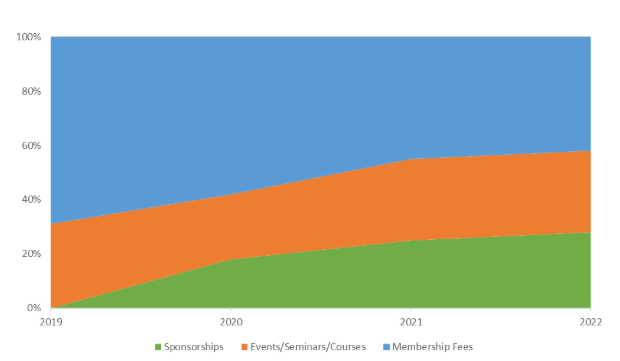
The shift of revenue sources from mostly membership fee-based to partly sponsors and partly membership
4. Reinforcing Resilience Through Inclusion
Challenge: An organization tried to create a sense of belonging for its members and retain its employees for the long term. Recruiting young members and underrepresented minorities was very hard. Equally, the organization was having difficulty keeping young employees on their payroll for more than six months. Relying on an aging workforce was not an option for the long term.
Solutions: Direct Objective Consulting conducted a 360-degree feedback analysis, learning that only 36% of the employees agree that their managers foster an inclusive environment. By implementing leadership training focused on diversity, equity, and inclusion (DEI) and an individualized action plan per executive, the leaders/managers of the organization learned how to foster a more inclusive environment across different departments.
Having set concrete KPIs and checklist guidelines enabled leaders to self-assess their progress. Leaders had access to a coach in case they needed extra support. Monthly recognition events celebrated leaders’ progression, while periodic external assessments ensured DEI program effectiveness.
Results: New younger professionals, including millennials and Gen Z, felt more connected and invested in the organization. That led to increased retention rates of employees and members. The association made an extra effort to represent underrepresented communities in order to get the full picture of its membership needs. As a result, the benchmark report results now reflected the reality of the association’s demographics. This inclusive environment fostered stronger engagement and retention, enhancing the organization’s overall effectiveness and reputation.

5. Sharpening The Value Proposition
Challenge: One organization was suffering from a diminished understanding of its value proposition, partly perceived as inconsequential or irrelevant. As a result, it was hard to retain existing members and recruit new ones.
Solution: Using the Continuous THRIVE Model, we suggested to conduct three studies:
- Market Perception Study – to better understand how this organization is widely perceived
- Stakeholder/Member Experience Assessment – to learn stakeholders/members’ needs, preferences, level of interaction, and expected value from the organization
- Satisfaction and Retention Data Analysis – to understand why existing members stay and why lapsed members leave
Through comprehensive research, Direct Objective pinpointed two insight factors: 1. the current services offered to members do not entirely address the members’ needs, and 2. the organization’s messaging was not coherent with members. Based on these findings, we suggested some adjustments to services. The positioning message was also sharpened to emphasize the organization’s core value proposition. A new lifecycle engagement program helped integrate the revised services and reinforce the new messaging.
Results: The sharpened value proposition addressed concerns from lapsed members and partners and allowed a quick understanding of the organization’s benefits. Service amendments reflected these updates, and a “What’s in it for me” Q&A clearly illustrated the association’s service benefits. By reinforcing these values at every touchpoint, member loyalty increased by 21% over 2 years.
Final Words
These stories highlight the adaptability and impact of the Continuous THRIVE Model on association success. By addressing the source of challenges with tailored solutions, associations demonstrated meaningful growth and became thriving organizations.
Ready to see how the Continuous THRIVE model can transform your organization? Contact us to learn more or start an association audit process as the first step.